

mitecars.com
email: [email protected]

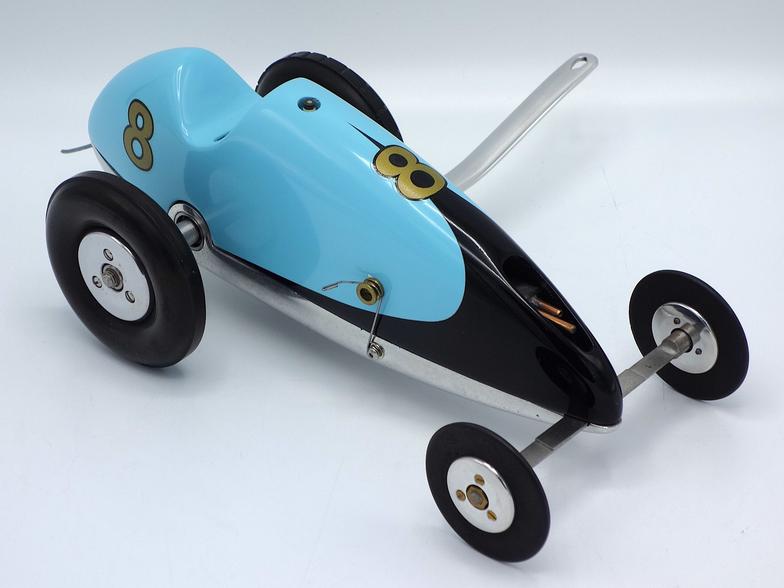
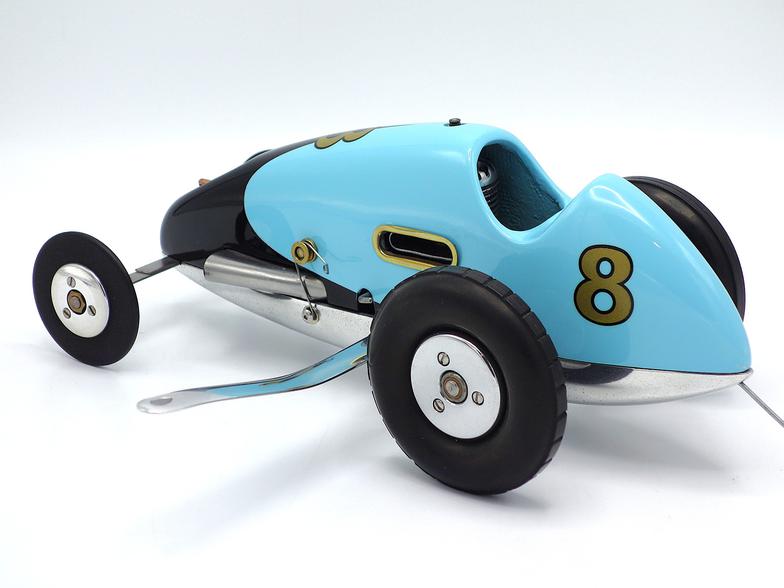
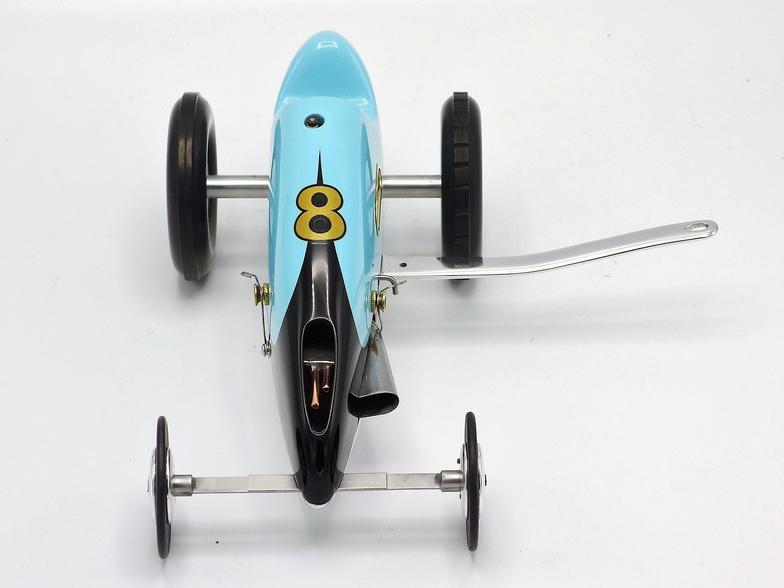
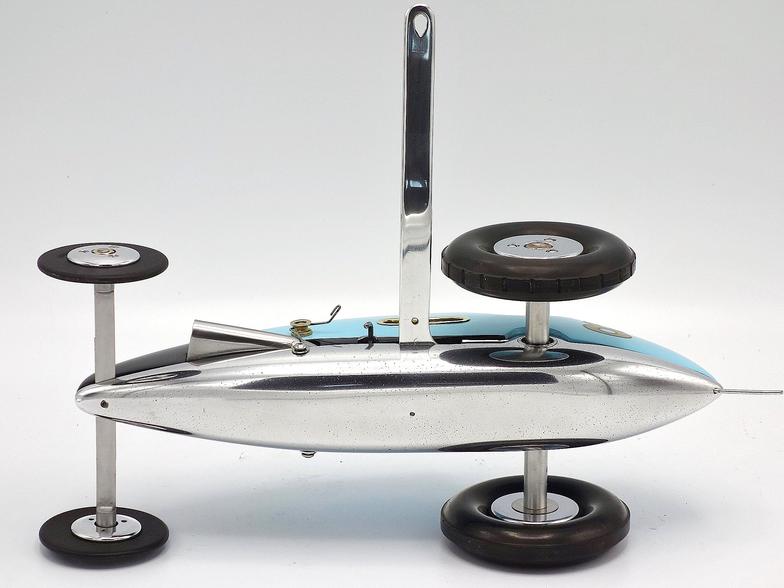
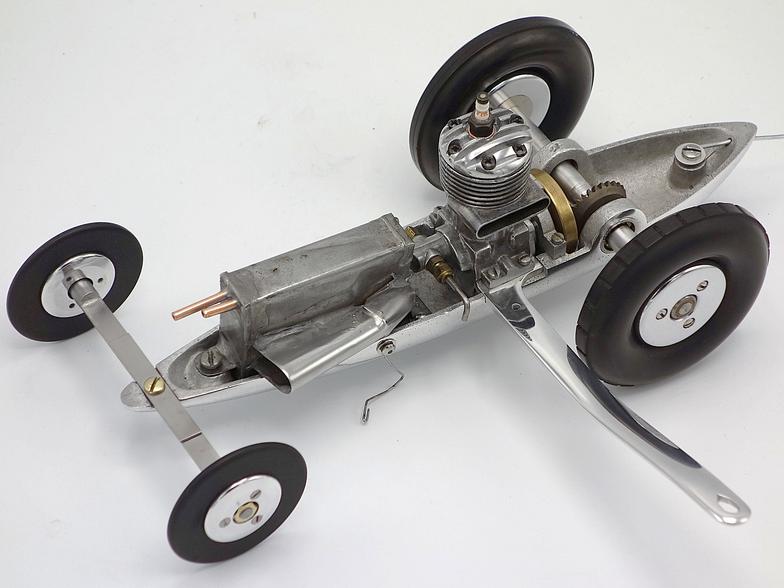
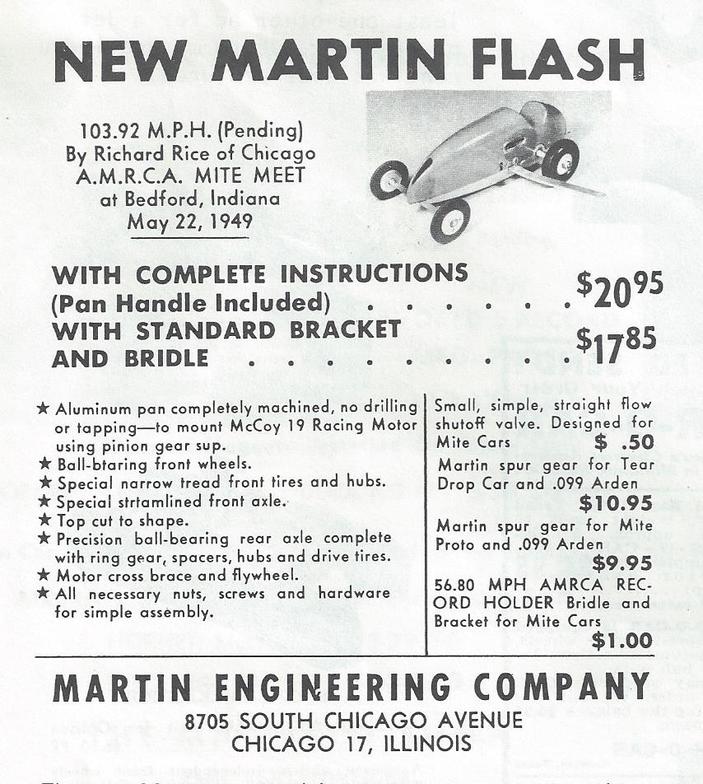
Martin Flash (early model)
Produced by Martin Engineering Co., Chicago, IL

The Martin Flash was designed by Anthony "Tony" Martin of Chicago, IL, and sold through his small company, Martin Engineering Co. Tony Martin designed the Martin Flash to be a formidable competitor racing in the
.19-class on tether car tracks across the country.
At the time of its introduction in early 1949, the use of a "pan handle" to attach the tether car to the cable was a relatively new idea and most competitors were still using a wire bridle to attach the car to the cable. As a result, early models of the Martin Flash could be ordered with either bridle brackets or a pan handle.
The early model pan castings had a small round "post" cast into both the front and the rear of the pan. These "posts" served primarily as mounting points for the bridle brackets, although the front "post" also served as a mounting point for the fuel tank and the rear "post" sometimes served as a mounting point for a wire tail skid. In later versions of the pan castings, the "posts" were replaced with beefier "steps" cast into the ends of the pan casting. The car shown in the photos is an example of an early model pan casting with the front and rear "posts".
The design of the pan handle also evolved over time. The early pan handle design featured a straight arm which was relatively close to the front of the left rear tire. This design would prove to be problematic as larger 3-inch diameter semi-pneumatic tires were fitted to the drive axle, since those tires tended to "grow" as their speed increased. As a result, it is not uncommon to find an early straight-armed pan handle with a notch cut in the trailing edge to provide additional clearance between the pan handle and the rear tire. The car shown in the photos has an early straight arm pan handle.
Early model Martin Flash cars also had a rectangular shaped fuel tank which partially blocked the air intake of the McCoy 19 engine. The fuel tank on the early model car shown in the photos has a small air scoop soldered to the side of the tank to direct air into the venturi, which has also been cut at an angle to further facilitate airflow into the venturi.
The earliest Martin Flash cars were fitted with two-piece aluminum front wheels which were actually the centers of 2 1/2 inch diameter Veco wheels. The Veco wheel halves were machined to accommodate ball bearings, and to clutch the narrow 2 inch diameter front tires which were simply die-cut from a 0.135 inch thick sheet of rubber. The two wheel halves were then secured to the tire with three 2-56 machine screws. The car shown in the photos is fitted with those early front wheels and tires.
Lastly, the earliest Martin Flash cars were originally fitted with 2 1/2 inch diameter Veco semi-pneumatic rear wheels and tires. However, as better wheels and tires became available, the cars were fitted with 3 inch diameter semi-pneumatic rear tires and Hornet Mite two-piece die-cast aluminum rear wheels. The car shown in the photos is fitted with 3 inch diameter rear tires mounted on Hornet Mite rear wheels.
